
A Soulful of Language
by Lisa Schantl
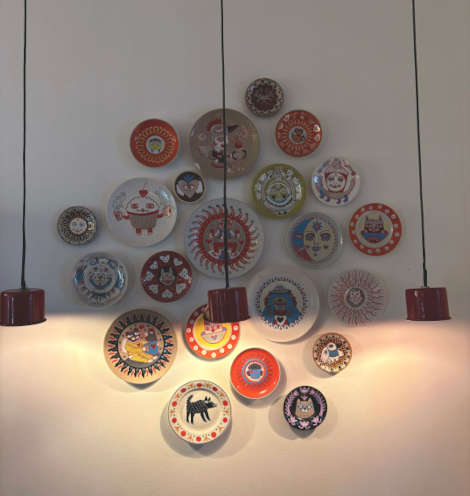
Cover image: Light outside one’s comfort zone. Photo © Onutė Dubakaitė 2025
Nestled inside my cubicle, I forget that I am in a country. On 14 square meters I blend into my one sofa/bed, my one cup, my one pot, my one chair. I might even forget the concept of countries – I certainly forget that countries have languages, and I forget that the language spoken in this country is not the one I grew up speaking, not the one I grew up learning, not the one I chose, not the many ones I tried, and certainly not the one an antique Greek teacher dumped on me many, many years ago (no, not Greek: Latin). Outside my room, the e is a schwa, the y is an i but not the English one, and the p’s and t’s just don’t want to be told from the b’s and d’s; and every time the endings are different.
For three days, I hide myself away in this sphere, caught in a web of stories and poems about faraway livelihoods – or, in other words: a massive submission pile for Tint Journal, the literary magazine I edit. Discourse time and life pass on the other side, the only relic of which is the occasional gush of fresh air from a briefly opened window.
In my Central-to-South European winter coat, gloves and a hat, I decide that it is time. I ready myself to face the Baltic cold and quickly come to learn that, in local terms, this is a warm winter’s day. In comparison to the locals, I seem overdressed, to put it gently, and in comparison to them, I do not recognize the sounds that the wintry wind blows against my lashes.
Lithuania, harsh and sweet
On Gedimino street, my surroundings wash over me, and I realize that I had not just hidden in a Woolf’ian enclave – my Room of One’s Own – but also stolen myself away into a linguistic universe not made to deal with the differences between ų, ū and u. In my cubicle, I was sucked into an online space, for the most part filled with English-language Zoom calls, podcasts and poetry, and German-language text messages. My thoughts were cushioned with both Germanic tribes, a consequence of many years of primarily bilingual nourishment.
I brace the current that is coming at me with full vigor now, and with much more than three differently pronounced u’s. Yesterday, I thought I had somewhat understood the world. Today, I realize, like countless times before, that this task probably is beyond anyone’s living capacities.
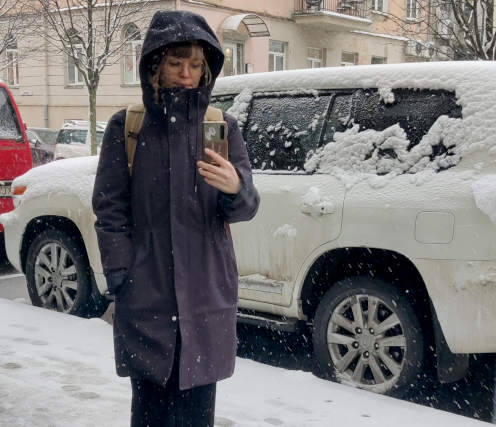
I primarily decided to leave my shell to get a real-life reminder of Lithuania’s sweets at one of my favorite places in this country’s capital, a vegan cafe serving exquisite cakes and even more exquisite tea varieties – regionally known as arbata. Inside, I order mėlynių su kardamonu or, as I gladly read out loud from the English menu: blueberries with cardamom. The blueberry jam melts in the boiling water, the cardamom smells sweet and spicy, the peas milk that I chose as an extra casts white spells into a deep purple sea.
Having settled down in my nook, the cup warms my hands that seem not made for this Northern hemisphere, stiff and coarse, more from wind than cold. The first sip is sweet, too sweet for my taste, like every sweet dish that I have had here so far. But three, four, five sips in, I have accommodated my buds to the sinful splendor and find myself wanting more and more of this delicacy.
When languages blend like jam in tea
The idea to blend jams and fruit sauces with hot water and refer to this as ‘tea’ still appears somewhat alien to me. Wherever I go, tea is one of the beverages that I will seek. I know that US citizens rarely serve herbal variants, that in Morocco tea means mint, an intense green, and lots and lots of sugar, and that in Thailand ordering green tea without any specification almost counts as an insult. I was not aware of the abundance I would be served in the Baltics.
Feeling the tiny beads of crumbs from the plant milk merge with the dense liquid on my tongue, I slowly warm up to the sounds of my environment. Behind my back, two young women have made their nest for the afternoon. With hot chocolate – notably, not hot cocoa, but seriously melted chocolate cubes with a dash of milk – and a coffee drink that looks like a cappuccino, but certainly is more than just that – probably the popular chai latte or a fancy caramel blend – they converse in what, after two months in this country, I still cannot distill into individual words even vaguely.
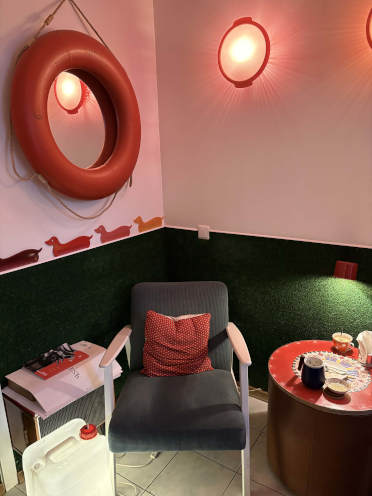
Photo © Onutė Dubakaitė 2025
Laba diena! as they say
On my one cupboard in my cubicle, five post-it notes document my beginning aspirations of linguistic adjustment. The declination of aš esu ‘I am’ and its negations; a phrase for hello ‘Laba diena!’ and a phrase for goodbye ‘Viso gero’; the numbers from one to ten; the most important word in every language, which is the one for thanks; and the basic states of feeling, from good to bad, with hand-drawn emojis next to the individual expressions for quick reference.
I have not made it past these five slides, mainly due to an unforeseen accident (as unexpected as these tend to be) that had me stay away from mentally exhausting activities for more than a month, and kept me impaired for at least another one. When my abilities to learn and digest finally were in the process of being restored, my new life reality requested me to formulate an updated set of priorities. Learning Lithuanian moved way down the ladder.
Still, it is fair to say that I owe much of my outside-of-my-squares existence to these five post-it notes and their contents. At All Hallow’s Eve, the woman outside Antakalnio kapinės asked me for vienas euras. I was purchasing a candle to light this evening in the cemetery. No, I’m not from Vienna, I first replied, unaware of the confusion that one number might be able to cause.
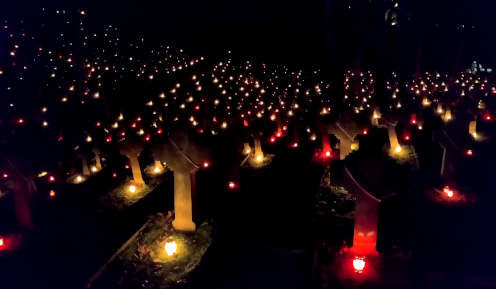
Photo © Lisa Schantl 2025
The woman looked at me in astonishment – probably because she had understood nothing of what I had just said, but more likely because I was not motioning to produce a one euro coin from my pockets. I then thought of my note: Vienas! Of course, the Lithuanian word for one.
I quickly explained my misunderstanding, which another person who was waiting in the line translanguaged to the salesperson in one way or another. We laughed, I paid, and smiled when I later lit the candle at one of the few graves that had not been paid a visit by their living relatives.
Counting in Zimt and yoga
Learning numbers is, as this lesson taught me, not by accident one of the first tasks in any foreign language course book. I have been recounting them silently: when I see a number on a car plate, when I call someone on the phone, when I open my door with its six-digit code, and whenever I see a price tag. My knowledge of Lithuanian numbers has, however, stalled with dešimt – ten.
With its false, but friendly kinship to the German word for cinnamon, Zimt, it keeps casting memories of cinnamon buns and gingerbread on my tongue whenever I hear it slurred across a counter. I have not climbed past this tasteful two-syllabic, two-digit item; there is no universe as of now in which I could guess eleven, twelve, not speaking of 34 or maybe 1,500. The year in which we live remains a German-English acquaintance only.
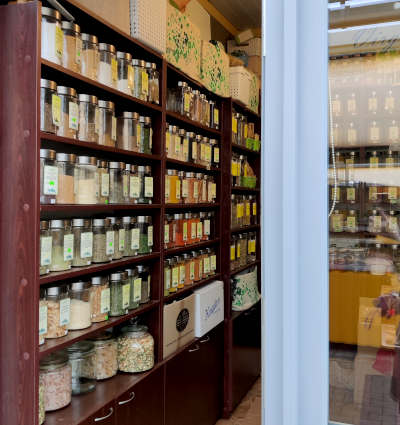
Photo © Lisa Schantl 2025
In yoga class, which I’ve picked up the habit of attending recently again, the teacher counts slowly: “Hold – penki, keturi, trys, du, vienas – and sink to the count of five – penki, keturi, trys, du, vienas.” My arms hurt, as they lower my body across the distance between straight-arm plank and belly-on-mat. There is a smile on my face, however, because I understand, because I am able to follow her into the world of her native tongue.
Tuesday and Thursday mornings, she opens the door to a foreign world to me, inviting me in at a pace that I can follow – one breath, one number at a time. After one of the more heat-spiking classes, she puts a bowl of meduoliai – the Lithuanian version of gingerbread – on the counter for the students to enjoy. She says, she brought nine, so it’s exactly one per person. I understand devyni and vienas; I understand.
That one soulful word, in every language
The saying goes that people in the North are more uptight, less approachable, and way less friendly than the people in the South. While there is a kernel of truth to that, to which I can attest from my own experiences not exclusively drawn from this one time in Vilnius, it only does so on the surface.
One word that certainly causes ripples in the stereotypical pond is ačiū – thanks. Someone holds a door, I say, ačiū; a car’s driver lets me walk across the street, I think, ačiū; the barista in this cafe fills my glass with tap water, I say, ačiū, thank you very much.
And it is this word that takes me into the conversation of the two young women with their tasty chocolate and coffee drinks right behind me. One arrived a few minutes earlier than the other, and carefully placed a bundle on the small coffee table that centers their chosen seating area. Just a few seconds after the other woman’s entrance, I hear, ačiū, awww, ačiū, you are so kind.
Almost as steadfast as ačiū is the random English sentence in the conversations by the Lithuanian members of my generation or younger. It blends into the language like milk blends into a delicious blueberry and cardamom arbata – a little crumbly, a little faint, but soft to the touch, a friendly alien, come to stay.
I do not get any of their verbal exchange that follows. What I do get, though, is the long hug they share, the tender touches, the soft vowels that are carefully blown towards the other, plosives and Soviet remembrances tucked aside for this precious moment. I finish my sweet drink, spoon the soaked blueberries from the bottom of the cup, one after the other, zip up and leave. Bye, I say as I exit the small space that is at maximum twice my room. Saying goodbye like the locals still does not come naturally to me.
English for beginners, and for comfort
Back on Gedimino street, the cathedral gazes at me with her majestic pillars and cast figures that populate every tourist’s camera within the first hours of their stay. They were also the first iconic images that I stored of this place, soon to be put in the shade of my many strolls along the Neris River, my swift walks up the Three Crosses Monument, my many attempts at finding the best dessert in a city made of desserts, and of the hours spent between library racks that more frequently than not speak to me in the symbols that I know best – the letters of the German and the English alphabet.
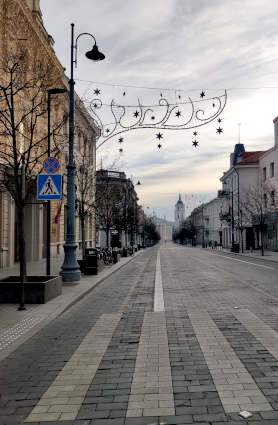
Photo © Lisa Schantl 2025
Maybe the desire to withdraw, from time to time, in nothing but the familiar, nothing but the most well-known, is at the core of the human being. Be that languages, people, places. No matter how much of a travel enthusiast, an adventure seeker, a cultural explorer I am: In my cubicle, my comfort zone, I curl up next to the source of warmth, whatever that may be, and I seek shelter and wisdom in the knowing.
I lived abroad before, a while ago, in the US. Settling into the slurred r’s and the waiter’s c-u-o-a-ffee took some weeks of adjustment, but the familiarity with the language – if only theoretical to this point – proved to be a sturdy shoulder to lean on. While I remember repeating numbers to an automated voice innumerable times, or having to spell my name every time I had to give it and still would wound up misunderstood, I got to terms with the way the Jersey and New York folks talk.
Towards the end of my stay, I had not only expanded my linguistic horizons to the West Coast and the South, but I had arrived in a state of awe of the many nuances that one language, even as simple as the English one, can take – and I am only speaking of the English spoken within the US.
Here, in Lithuania, I live in a country in which I cannot even guesstimate the language. To say it quite frankly: I am out of my conversational depth. An occasional step aside to let the air be air and my head be filled with familiar rhythms and sounds is like a five-star spa retreat. Primed for language analysis and metaphors by passion and occupation, my brain – when let loose – will try to find a clue for every puzzle piece. More often than not, however, I am left with false friends and a smile on my face that says, no, I do not even pretend to get that.
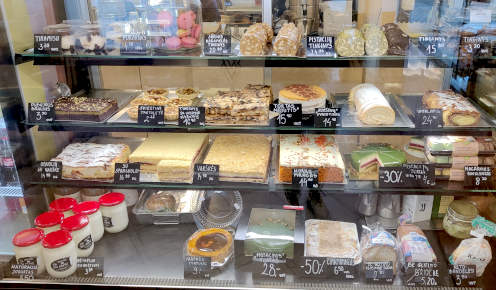
Photo © Lisa Schantl 2025
Yet, if we stay too long in our spa resorts, in our comfort zones, we might forget that the same winds that make our eyes teary, and us want to seek shelter, are also the ones that lift our kites, and help us see the world from a fresh perspective. It is this perspective that can make us aware of all that it is that we have in common, all that sets us apart, and how we can learn from each other across linguistic differences, and by a desire for and trust in mutual intelligibility.
When you do not understand, and yet you do
My encounter with the Lithuanian language and its speakers opened my eyes and ears to the many forms a word can take. It has also brought to me a much deeper understanding of the multiple shapes that friendliness, closeness, and appreciation can show up in. It has become a token for the warmth and enlightenment that so often follows a brief, unexpected stir.
For my final stop on this day, I enter a flower shop. “Is English okay?” I ask, hesitantly, and the two women florists look at each other, foretelling the desperation that my visit might cast over the rest of their afternoon. I point at a small tree, and with the help of our eyes and hands we pick a red pot that fits it just wonderfully.
I gesture at a wooden star in white paint and draw a Schleife in the air because the English word has suddenly become just as elusive as its Lithuanian equivalent – yes, I would like some decoration on it, please. The live tree does not handle decoration well; this I come to understand after some back and forth between the back room and the counter, involving a demonstration of used ornaments and the promised desperation flaring up in the florists’ eyes. Their creativity comes to full show as they focus on the pot and style this one instead. I tip with a little extra, and they glare at me widely. Ačiū, I say, and so do they.
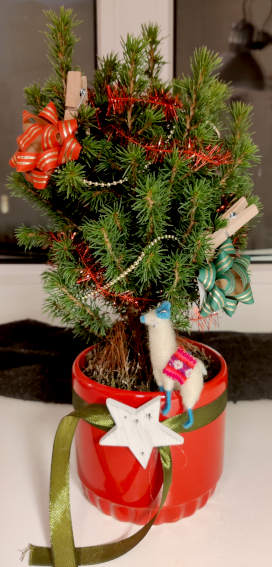
Photo © Lisa Schantl 2025
*
Woolf, Virginia 1929. A Room of One’s Own. London.